What a listed developer has to tell you, and what to check at Prestige
Most builders in India are private companies. They tell you what they choose to tell you. A listed developer does not have that option. A buyer who knows where to look can check things about Prestige that are simply unavailable for most of its competitors.
The short answer
Prestige Estates Projects is listed on the Indian stock exchanges. It must publish audited results every quarter, disclose borrowings, submit to credit rating agencies, and report material events within tight deadlines. None of that is optional, none of it is marketing, and all of it is free to read. For a buyer this is a diligence advantage worth using. It is not the same thing as a guarantee about your flat, and at Prestige Parklane there is an extra step to understand first.
What a listed developer must publish
| Disclosure | How often | What a buyer learns |
|---|---|---|
| Audited financial results | Quarterly and annual | Revenue, profit, and whether the trend is improving or deteriorating |
| Collections against sales | Quarterly | Whether money is actually arriving, or only being contracted |
| Borrowings and net debt | Quarterly and annual | How leveraged the builder is, and the direction of travel |
| Credit ratings | Reviewed periodically | An independent agency's read on the ability to service debt |
| Material events | Within days | Litigation, regulatory action, large transactions, management change |
| Shareholding pattern | Quarterly | Promoter holding, and whether shares are pledged |
Compare that with an unlisted builder, where a buyer typically has only the RERA filing and whatever the sales team says. The RERA filing is the more important of the two. But it is project-level and backward looking. It tells you nothing about whether the company behind it is under strain.
The four things worth actually checking
1. Net debt, and the direction. Absolute debt is less informative than the trend. A developer reducing leverage while growing sales is in a different position from one whose debt rises alongside its pipeline. Both can be fine. Only one is fine without further questions.
2. Collections against sales. Sales are signed contracts. Collections are money received.
A widening gap is the earliest visible sign of trouble. It appears in the quarterly numbers long before it appears on a construction site. On FY26 figures, Prestige reported collections of about ₹18,515 crore against sales of about ₹30,024 crore, roughly 62 per cent.
3. The credit rating and its outlook. Rating agencies publish rationales, not just grades. The rationale is where the useful detail sits. An outlook change from stable to negative is worth reading even when the grade itself is unchanged.
4. Promoter share pledging. Pledged promoter shares are not automatically alarming. But a high or rising proportion is a liquidity signal, and it is disclosed every quarter. The reported figures are summarised on public filing aggregators, and the underlying filings sit with the exchanges.
The extra step at Prestige Parklane: which entity is the promoter
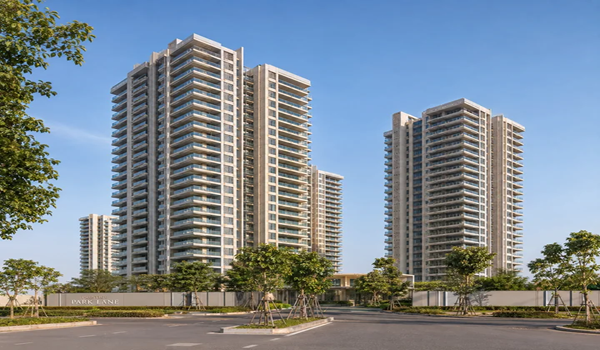
This is where the listed-developer argument needs care, and the RERA filing is specific about it. The promoter of record for Prestige Parklane is Apex Realty Management Private Limited. It is a private company within the Prestige group, not the listed Prestige Estates Projects Limited.
- CIN: U45200KA2018PTC119740, which marks a private company incorporated in Karnataka in 2018.
- Registered office: Prestige Falcon Towers, No. 19 Brunton Road, Bengaluru 560025.
- Managing director: Zayd Noaman.
- Promoter website on the filing: prestigeconstructions.com.
That structure is common and entirely proper. Developers routinely register individual projects through special purpose entities. But it changes what the listed disclosures tell you. The quarterly results describe the listed parent and the group. They do not publish Apex Realty's own balance sheet. So the disclosures are context about the organisation behind this project, not a direct read on the entity carrying its obligations.
Where to find Apex Realty's own finances
Because Apex Realty is private, its accounts do not reach the stock exchanges. They do reach the RERA register. Parklane's filing attaches the promoter's own documents, and they close much of the gap the listed disclosures leave.
| Document on the RERA filing | What it tells you |
|---|---|
| Audited balance sheet, FY 2023-24 and 2024-25 | Assets, liabilities and net worth of the promoter entity itself |
| Audited profit and loss statement | Whether the entity is operating profitably |
| Cash flow statement | Whether cash is actually moving through the business |
| Income tax return acknowledgements | That returns were filed for both years |
| CA, architect and engineer certificates | Independent professional sign-off on cost and construction |
| Land litigation affidavit | A sworn declaration of no litigation on the land, property or khata |
Read them in this order: the listed parent's results for group context, then the promoter's own filed accounts for the entity that carries your project.
The questions that close the gap
- Which entity signs the agreement for sale?
- Does the listed parent provide any guarantee or support for this project?
- Is the promoter entity the same one named on every document you receive?
Ask these before you sign, and get the answers in writing.
Where the advantage stops
Be precise about this, because it is where the argument is usually overstated.
Listing is a company-level signal. It says nothing about the timeline on your tower. A group can be in excellent health and still deliver one project late, and the quarterly results will not show it.
Your protection is the RERA filing, not the balance sheet. The declared completion date, the escrow on 70 per cent of collections and the compensation for delay are project obligations. They are the things you can enforce.
Disclosure is not endorsement. A listed company publishes bad news too, on a deadline. That is the point. The advantage is that you get to see the bad news, not that there is none.
How this applies now that Parklane is registered
Prestige Parklane registered under PRM/KA/RERA/1251/309/PR/150926/008941 on 15 September 2026. The project-level protections are now in place. So use both layers of information together, and in the right order.
- The RERA filing first. It binds the project: completion by 31 December 2030, escrow, delay remedies.
- The promoter entity second. Confirm who signs, and whether the parent stands behind it.
- The listed disclosures third. Read them for the group's financial direction, as context.
Frequently asked questions
Yes. Prestige Estates Projects is listed on the Indian stock exchanges, which obliges it to publish audited results, disclose borrowings and shareholding, and report material events on deadlines.
No. The RERA promoter is Apex Realty Management Private Limited, a private group company with CIN U45200KA2018PTC119740, rather than the listed parent.
Audited quarterly results, collections against sales, net debt and its direction, credit ratings with rationales, promoter pledging, and material events such as litigation.
It reduces the risk of the group failing mid-construction. It creates no obligation on your apartment. Delivery protection comes from the project's RERA registration.
Collections measured against sales. A widening gap between them is the earliest visible sign of stress, well before it shows on site.
Which entity signs the agreement for sale, whether the listed parent guarantees the project, and whether every document names the same promoter.