Booking at Prestige Parklane: from EOI to allotment, step by step
A buyer wrote in asking whether the expression of interest they had filled in meant they had a flat. They had paid nothing and signed nothing. They were fairly sure the answer was no, but nobody had said so plainly. So here is the sequence at Prestige Parklane, step by step. It covers what each step does and, more usefully, what it does not do.
The short version
Nothing reserves an apartment until you hold an allotment letter naming a specific unit. Nothing binds the developer until a sale agreement is executed and registered. Everything before that is queue management.
That is not a criticism of the process. It is simply what the process is, and knowing it stops you relaxing too early. One thing has already changed in your favour. The project registered with Karnataka RERA on 15 September 2026, under PRM/KA/RERA/1251/309/PR/150926/008941, so the statutory protections now apply to money paid.
The five stages
| Stage | What you pay | What it gives you |
|---|---|---|
| 1. Expression of interest | Nothing | A place on the contact list. No unit, no price, no obligation either way. |
| 2. Survey or preference form | Nothing | Your stated preference of configuration, tower and facing, and a queue position. |
| 3. Allotment | 10 per cent | A named unit, against a receipt and an allotment letter. |
| 4. Agreement | A further 10 per cent | A sale agreement, executed and registered. |
| 5. Date-linked instalments | 24 × 3.2 per cent, then 3.2 per cent | Progress, and eventually the occupancy certificate. |
Stage 1: The expression of interest
An EOI costs nothing and creates no obligation on either side. It is not a booking, not a token, and not a claim on a unit. What it does is put you on the list that gets the survey form, the price list and the unit plans before public release.
On a project with 1,788 apartments and a compressed allotment window, that early access is the whole point of filing one. If anyone asks you for money at this stage, that is not an EOI. Ask what the payment is for, and get the answer in writing before you send it.
Stage 2: The survey form and queue position
The survey form opens on 25 September 2026 at 5 PM. It captures your preferred configuration, tower and facing. Submission order sets queue position. Queue position decides who gets first pick when allotment opens. Two things are worth knowing about this stage.
Your preference is a preference, not a reservation. Stating one does not commit you to buying. And a good queue position is worth far less than a decision you have already made. The work belongs before the form opens, not during it.
Settle these before the form goes live
- Configuration. Each of the nine towers holds one band of homes, so this largely decides your tower too.
- Your ceiling on the total cost to own, not the headline price.
- Two towers you would accept, in order.
- Your facing, read from the master plan rather than described over a phone.
Stage 3: Allotment, and the first money that matters
Allotment is the first point at which a specific apartment becomes yours to buy. Ten per cent is payable. What you receive in exchange should be an allotment letter, not a text message.
Check that the allotment letter names all of these:
- The tower, floor and unit number, not just a configuration.
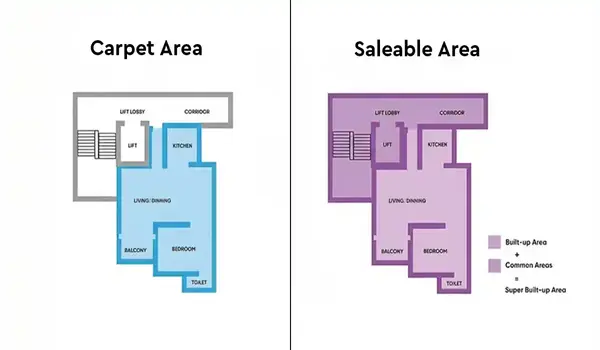
- The saleable area in square feet, and the carpet area alongside it.
- The price for that unit, and exactly what "all inclusive" covers for it.
- The possession-stage charges: BESCOM, BWSSB, generator, advance CAM and corpus.
- The full payment schedule, with the date for each instalment.
- What happens to your money if you withdraw, and within what window.
The last one is the one people skip. Ask for the cancellation terms in the letter itself, rather than accepting a verbal assurance.
Work from the total, not the headline
Parklane's starting prices are stated as all inclusive, excluding registration. That narrows the gap between headline and total, but does not close it. Possession charges and 7.5 per cent registration add roughly 11 to 12 per cent. On a ₹90 lakh 2 BHK, the total comes to about ₹1.01 crore.
Stage 4: The agreement, and the RERA line
This is the stage that actually changes your legal position. Under the Real Estate (Regulation and Development) Act, a promoter cannot accept more than ten per cent of an apartment's cost upfront. Beyond that, it must first enter into a written agreement for sale and register it. Because Parklane is now registered, the protections behind that rule are live.
- A registered agreement for sale the Act can enforce for you.
- An escrow requirement holding 70 per cent of collections against certified progress.
- A declared completion date of 31 December 2030, with delay remedies attached.
The practical rule still stands. Do not go past ten per cent before you have a registered agreement in hand. That is not excess caution. It is the line the Act itself draws. When the agreement comes, read the possession date, the delay compensation clause and the specification schedule. Those three decide what you can hold anyone to later.
Stage 5: Date-linked instalments
Here Parklane differs from the common pattern, and it is worth being clear-eyed about it. The balance is not tied to construction milestones. It runs on fixed calendar dates.
| Stage | Share | When |
|---|---|---|
| Booking | 10% | At allotment |
| Agreement | 10% | On initiation of agreement |
| Instalments 1 to 24 | 3.2% each | Every two months, 10 December 2026 to 10 October 2030 |
| Possession | 3.2% | On intimation of possession, with possession-stage charges |
On a construction-linked plan, no slab means no demand. Here, demands arrive on the calendar whether or not the building keeps pace. If you are borrowing, note what that means. Banks usually disburse against certified construction, so a demand can fall due before the bank releases the matching tranche. Keep a cash buffer.
Red flags in an allotment letter
Most allotment letters are fine. These are the signs that one needs a second read before you pay.
- No unit number. A configuration alone, such as "a 2 BHK in Tower 9", is not an allotment.
- Saleable area with no carpet area. The Act requires carpet area, so its absence is a question.
- A promoter name that differs from the RERA filing. The registered promoter is Apex Realty Management Private Limited.
- A registration number that differs from PRM/KA/RERA/1251/309/PR/150926/008941.
- Payment to an individual or to any account other than the promoter's.
- Cancellation terms marked "as per company policy" instead of written out.
- A payment schedule that does not match the published date-linked plan.
Any one of these is worth resolving in writing before the cheque. Two or more is a reason to pause.
The first 30 days after allotment
Allotment starts a short sequence that is easy to let drift. Keep it moving.
- Store the allotment letter and receipt together, scanned and on paper.
- Send the letter to your lender if you are borrowing, and confirm the project's APF status.
- Arrange registration cash at 7.5 per cent, since the agreement will need it.
- Read the draft agreement with an independent lawyer before signing, not the developer's nominee.
- Diarise the instalment dates, starting 10 December 2026, every two months.
Doing these early turns allotment into a controlled process rather than a series of surprises.
What to have ready before you start
- PAN and Aadhaar for every applicant, and address proof that matches them.
- A decision on joint ownership, made before the allotment letter is drawn. Changing names afterwards means a fresh letter and sometimes a fee.
- For an NRI: passport, visa or OCI, and the NRE or NRO account the payments will run through.
- A loan pre-approval if you are borrowing, obtained before the survey form opens.
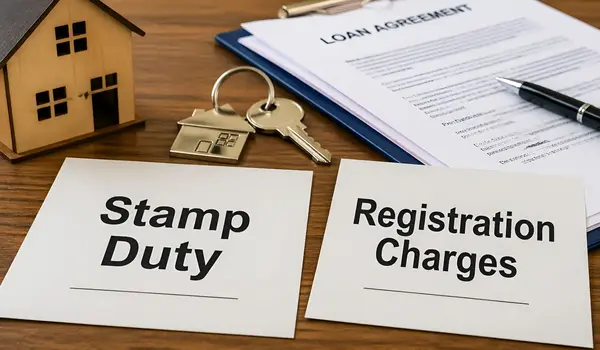
- Cash for registration: 5 per cent stamp duty, 0.5 per cent cess and 2 per cent registration fee in Karnataka, 7.5 per cent in all.
The four mistakes we see most
Treating the EOI as a booking. It is not one. A buyer can lose a month assuming they are already in the queue for a unit.
Budgeting on the headline. Possession charges and registration sit on top of the all-inclusive price. Decide your ceiling on the total.
Picking the tower in the room. Facing, floor and the view out of a G+24 tower are the one thing you cannot change later. Decide them from the master plan beforehand.
Assuming payments pause if building slows. On this date-linked schedule they do not. Plan your cash flow for the calendar, not the construction.
Frequently asked questions
No. An EOI costs nothing, commits neither side, and gives early access to the price list and unit plans. A unit is reserved only at allotment, against payment and a letter naming the apartment.
Ten per cent on allotment, and a further ten per cent at agreement. Under RERA a promoter cannot take more than ten per cent without a registered agreement for sale.
On 25 September 2026 at 5 PM. Submission order sets queue position, which decides priority of tower, floor and facing.
Yes, since 15 September 2026, under PRM/KA/RERA/1251/309/PR/150926/008941. That means the escrow requirement and delay remedies apply to money paid.
No. After 20 per cent at booking and agreement, 24 instalments of 3.2 per cent fall every two months from December 2026 to October 2030, then 3.2 per cent on possession.
PAN and Aadhaar for every applicant, matching address proof, and a loan pre-approval if you are borrowing. NRIs also need a passport, visa or OCI, and an NRE or NRO account for payments.
It is possible but usually means a fresh allotment letter and sometimes a fee. Decide joint ownership before the letter is drawn, especially if you want a shared home loan tax benefit.
It depends on what the allotment letter says, which is why the cancellation terms should be in the letter before you pay. If the developer misses the declared completion date, the Act gives you withdrawal rights.