NRI guide to buying property at Devanahalli
The Devanahalli corridor draws an unusually high share of NRI buyers, for an obvious reason. When you fly in three times a year, being close to the terminal is worth something every single trip. The rules governing that purchase are straightforward, and they are not the ones most people assume.
This is general information, not legal or tax advice. Rules change and individual circumstances differ. Confirm with a chartered accountant before you transact.
Can an NRI buy property in India?
Yes. Under FEMA, a Non-Resident Indian or a Person of Indian Origin may buy residential and commercial property in India without RBI permission. There is no limit on how many. What you may not buy is agricultural land, plantation property or a farmhouse. Those can only come to you by inheritance.
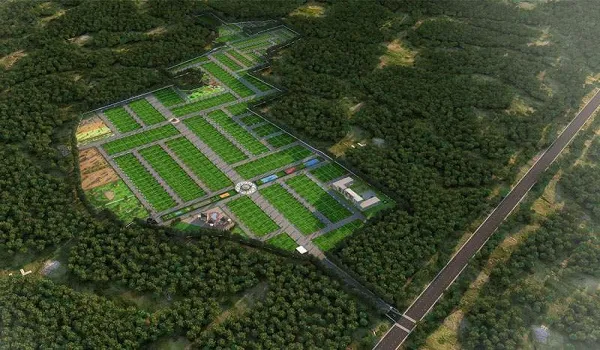
An apartment in a KIADB-zoned development is plainly residential property, so the restriction is not in play here. It is worth knowing if you are also weighing plotted developments on the corridor. Confirm the land's classification before you commit, because plots and apartments are not equivalent on this point.
How the money moves
Payment must be made in Indian rupees through normal banking channels. In practice that means:
- Inward remittance from abroad, or
- Funds from an NRE, NRO or FCNR(B) account.
You cannot pay by traveller's cheque or foreign currency notes. The account you pay from matters later, so decide it before the first instalment, not after.
NRE versus NRO, and why it decides your exit
This is the single most consequential choice in the whole process.
Pay from an NRE account, and the sale proceeds of up to two residential properties are freely repatriable, up to the amount originally remitted in foreign exchange.
Pay from an NRO account, and repatriation falls under the general USD 1 million per financial year limit, with Form 15CA and 15CB certification from a chartered accountant. Buyers routinely pay from whichever account has the balance, and discover the difference years later at sale. If repatriating the proceeds matters to you, route the purchase through NRE from the beginning.
Plan for the date-linked schedule
Prestige Parklane's payments run on fixed calendar dates, not construction milestones. After 10 per cent on booking and 10 per cent on agreement, 24 instalments of 3.2 per cent fall every two months from 10 December 2026 to 10 October 2030. From abroad, that suits a standing instruction. Set up remittances or NRE transfers against the dates, so no instalment is missed across a time zone.
Home loans for NRIs
Indian banks lend to NRIs. SBI, HDFC and ICICI all run NRI home loan products, typically at similar or slightly higher rates than resident loans. In August 2026, resident rates ran from about 7.25 per cent at SBI and 7.50 per cent at ICICI, against an RBI repo rate of 5.25 per cent. The practical differences for an NRI borrower:
- Tenure is usually shorter, often capped around 15 to 20 years and tied to your remaining working life.
- Loan to value is broadly the same, up to about 80 per cent.
- Repayment must come through NRE, NRO or FCNR accounts, or by direct remittance.
- Documentation is heavier: passport and visa, overseas address proof, employment contract, overseas salary slips, bank statements, and often an attested Power of Attorney.
Power of Attorney, and the clause that matters
Most NRI buyers execute a PoA so a trusted person in India can sign the agreement, complete registration and take possession. Executed abroad, it must be signed before the Indian consulate, or notarised and apostilled. It must then be stamped in India within three months of receipt.
The part to get right: make it a specific PoA naming this transaction and this property, not a general one. A general PoA hands broad authority over your affairs to someone who may not need it. It is very hard to unwind at distance. Name the acts: execute the agreement, present for registration, take possession, receive keys. Nothing wider.
Tax, in four parts
On purchase
TDS at 1 per cent applies where the consideration exceeds ₹50 lakhs. Buying from a developer is straightforward. Buying resale from another NRI is not. TDS then runs at 20 per cent plus surcharge and cess on the whole consideration, not the gain, and the buyer needs a TAN. Get advice first.
On registration
Karnataka charges the same regardless of residency: 5 per cent stamp duty, 0.5 per cent cess and a 2 per cent registration fee above the ₹45 lakh slab. That is 7.5 per cent in total. The registration fee rose from 1 per cent on 31 August 2025. A lot of published guidance still carries the old number.
On rental income
Rent is taxable in India. The tenant must deduct TDS at 30 per cent plus surcharge and cess on rent paid to an NRI. You then file a return and claim any refund. Check the Double Taxation Avoidance Agreement between India and your country of residence. It usually prevents the same income being taxed twice.
On sale
Held over 24 months, gains are long term. Under 24 months, they are short term and taxed at slab rates. Recent Finance Act changes set long-term gains on property at 12.5 per cent without indexation.
The older option of 20 per cent with indexation applies only to property acquired before a 2024 cut-off. A Parklane purchase in 2026 falls under the 12.5 per cent rule. Exemptions under Sections 54 and 54EC are available to NRIs on the same terms as residents. Confirm your own position with a CA.
Buying from abroad: three cautions
You cannot walk the site. Everything about standing on the ground at a busy hour, listening for aircraft and checking what sits opposite applies doubly at 4,000 miles. Send someone you trust, with a written list of questions, and ask for photographs and video at the times that matter.
Verify the RERA registration yourself. Do not accept a screenshot. The Karnataka RERA portal is public and reachable from anywhere. Prestige Parklane is registered under PRM/KA/RERA/1251/309/PR/150926/008941, granted 15 September 2026. Check that the sixth segment reads PR, which marks a project rather than an agent.
Match every document to the filing. The promoter on the filing is Apex Realty Management Private Limited. Make sure your agreement, receipts and PoA all name the same entity and registration number.
Why this corridor specifically
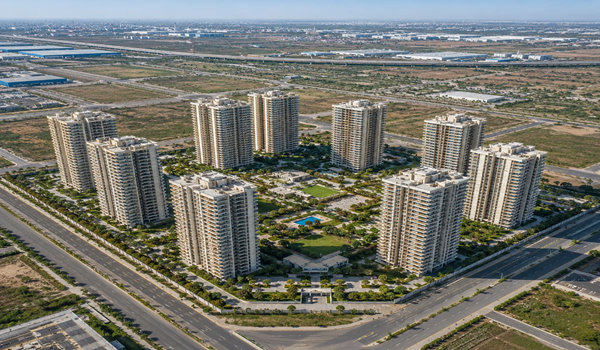
The site is roughly seven kilometres from the terminal area of an international airport handling 44.47 million passengers a year. Its two parallel CAT-IIIB runways keep operating in fog when some North Indian airports close. A 460 acre business district is being built inside the airport boundary. For a buyer whose relationship with the property is measured in trips rather than commutes, that is the whole argument.
Frequently asked questions
Yes. Under FEMA an NRI or PIO can buy residential and commercial property without RBI permission, with no limit on the number. Agricultural land, plantations and farmhouses are excluded.
NRE, if you may want to repatriate the sale proceeds. NRE-funded purchases allow proceeds of up to two properties to be repatriated freely, up to the amount remitted.
Yes. SBI, HDFC and ICICI offer NRI home loans, usually up to about 80 per cent of value, with shorter tenures and heavier documentation than resident loans.
Long-term gains, after 24 months, are taxed at 12.5 per cent without indexation for property acquired in 2026. Short-term gains are taxed at slab rates.
Yes, since 15 September 2026, under PRM/KA/RERA/1251/309/PR/150926/008941. Verify it yourself on the Karnataka RERA portal.
Not always, but most use one so a trusted person can sign and register in India. Use a specific PoA naming this property and these acts, not a general one.