Home loan interest before possession: what happens to it
This is the question buyers of unbuilt homes ask most often, and almost always too late. You start paying the bank in year one. You get the keys in year five. What happens to all that interest in between?
The short answer
You cannot claim home loan interest while the property is under construction. You claim it afterwards, in five equal instalments, starting from the financial year in which construction completes. The interest does not vanish. It waits. For many buyers, though, it waits only to be absorbed by a ceiling it can never fit under. And a deadline almost nobody mentions at booking can shrink that ceiling further.
What the law calls it
The interest you pay between taking the loan and the year construction finishes is pre-construction interest. Section 24(b) of the Income Tax Act allows it, but not in the year you paid it. Instead you total it across those years, split the total into five, and claim one fifth each year for five years. That begins in the year the property is completed, on top of the normal interest you pay in those same years.
| Period | What happens | What you can claim |
|---|---|---|
| Construction years | You pay interest, often pre-EMI only | Nothing, that year |
| Year of completion | Property ready, possession taken | Current year interest, plus one fifth of accumulated pre-construction interest |
| Next four years | Normal repayment | Current year interest, plus one fifth each year |
All of it sits under the same ceiling. That ceiling is where people get hurt.
The five year rule, which is the part that costs money
For a self-occupied property, the ₹2 lakh interest deduction under Section 24(b) has a condition attached. Construction must complete within five years from the end of the financial year in which the loan was taken. Miss that window and the ceiling collapses from ₹2 lakh to ₹30,000.
That is a ₹1.7 lakh swing in deduction every year. On a 30 per cent slab it is over ₹50,000 of real tax, annually, lost to a delay you did not control. And the clock does not start when the builder starts work. It starts from the end of the financial year in which you took the loan.
Running the test on Prestige Parklane
For most projects this test has to be run on a guess. For Parklane it can now be run on filed dates. The project is registered under PRM/KA/RERA/1251/309/PR/150926/008941, with a declared start of 1 October 2026 and completion of 31 December 2030. The first date-linked instalment falls on 10 December 2026, which is inside financial year 2026-27.
| If your first disbursement falls in | Five-year deadline | Headroom after 31 Dec 2030 |
|---|---|---|
| FY 2026-27 (by 31 March 2027) | 31 March 2032 | About 15 months |
| FY 2027-28 (from 1 April 2027) | 31 March 2033 | About 27 months |
On the declared date, both pass. The difference is how much delay you can absorb before the ceiling collapses. Fifteen months is a reasonable buffer. Twenty-seven months is a comfortable one, and on a G+24 build over three basements that difference is worth having.
A worked example on the real schedule
Take a 1 BHK at ₹65 lakhs, with an 80 per cent loan of ₹52 lakhs at 7.75 per cent. On the Parklane schedule, the 20 per cent paid at booking and agreement is your own money. The bank then funds the 24 instalments of 3.2 per cent, released every two months from December 2026 to October 2030.
| Line | Amount |
|---|---|
| Bank-funded through the 24 instalments | About ₹49.9 lakhs |
| Pre-construction interest to 31 December 2030 | About ₹8.3 lakhs |
| One fifth, claimable each year for five years | About ₹1.66 lakhs |
| Ordinary interest in the first year after completion | About ₹4.0 lakhs |
| Ceiling for a self-occupied home | ₹2.0 lakhs |
Here is the uncomfortable part. Ordinary interest in the first year, about ₹4 lakhs, is already double the ₹2 lakh ceiling on its own. So the ₹1.66 lakh of pre-construction interest adds nothing for a self-occupied owner in that year. It is entirely absorbed. On a loan this size, most of the ₹8.3 lakhs of pre-construction interest will never reduce your tax at all.
That is not a reason to avoid an under-construction home. It is a reason to stop treating the tax benefit as a line in the affordability case. Treat it as a small rebate that may not arrive, not as something that makes the EMI cheaper.
How a joint loan changes the answer
The absorption problem above is a single-borrower problem. A joint loan can largely solve it. Where two people are both co-owners and co-borrowers, each can claim up to ₹2 lakh of interest. Together that is a ₹4 lakh ceiling.
| 1 BHK, ₹52 lakh loan, first year after completion | Single borrower | Joint borrowers |
|---|---|---|
| Ordinary interest that year | About ₹4.03 lakhs | About ₹4.03 lakhs |
| Interest ceiling | ₹2 lakhs | ₹4 lakhs |
| Interest actually deductible | ₹2 lakhs | About ₹4 lakhs |
| Room left for pre-construction interest | None | Very little |
So a joint loan roughly doubles the deduction you actually use on ordinary interest. It still leaves little room for the deferred amount on a loan this size, but it recovers far more tax overall. Both conditions must hold. A co-borrower who is not on the title cannot claim. A co-owner who does not service the loan cannot claim either.
Self-occupied or let out: the comparison
How you use the home after completion changes the treatment materially.
| Self-occupied | Let out | |
|---|---|---|
| Interest deduction ceiling | ₹2 lakhs per borrower | No cap on interest against rental income |
| Loss set off against other income | Within the ₹2 lakh limit | Limited to ₹2 lakhs a year |
| Unabsorbed loss | Lost | Carried forward eight years |
| Five-year rule applies | Yes | The ₹30,000 collapse applies to self-occupied |
| Available in the new regime | No | Interest against rent, yes |
For an investor letting a 1 BHK to the corridor workforce, the deferred interest has a real chance of being used over time. For an owner-occupier on a single loan, it largely does not.
Keep a running record from year one
The five-year claim starts four years after the interest was paid. By then nobody remembers the figures.
- Save the lender's interest certificate every year, even though you cannot claim it yet.
- Keep a simple running total of interest paid before completion.
- Note the financial year of your first disbursement, since it sets the deadline.
- File the possession letter and occupancy certificate, which prove the completion year.
The practical moves
Consider delaying the first disbursement. The clock runs from the financial year of the loan, not the booking. At Parklane, the December 2026 and February 2027 instalments fall in FY 2026-27. Funding those two yourself, about ₹4.16 lakhs on a ₹65 lakh home, pushes the loan into FY 2027-28 and buys a further year of headroom.
Anchor on the RERA date, not the brochure. The declared completion date is an obligation the developer carries. A brochure estimate is not.
Model the bad case. Run your numbers at ₹30,000 as well as ₹2 lakh. If the purchase only works on the ₹2 lakh assumption, you are relying on a schedule holding for half a decade.
If you are letting it out, the maths changes. For a let out property the interest deduction is not capped the same way, though loss set off against other income is restricted to ₹2 lakh a year. The balance carries forward for eight years. Take this to your CA.
Check your tax regime. Under the new regime the Section 24(b) deduction for a self-occupied property is not available at all. If you have moved to it, this entire calculation is academic for you.
Where GST fits
An under construction purchase normally attracts 5 per cent GST with no input credit. A completed property with its occupancy certificate attracts none. On ₹65 lakhs that is ₹3.25 lakhs. Parklane's fact sheet states its starting prices as all inclusive, excluding registration. Confirm in writing how GST is treated inside that figure for your unit.
Put it together and the honest picture is this. Buying early costs you GST and delays your interest deduction. What you get in return is a lower entry price and first pick of floor and facing. That is the actual trade, and it is a fair one. Just make it with your eyes open.
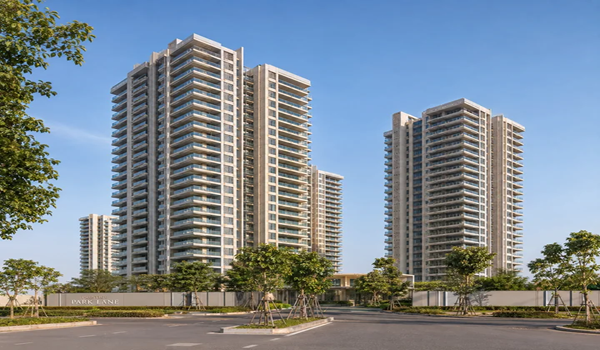
Prestige Group Prelaunch Project is Prestige Parklane.
Frequently asked questions
Not in the year you pay it. Interest paid before completion is pre-construction interest, claimed in five equal instalments from the financial year construction completes, under Section 24(b).
Interest paid from the date of borrowing until the end of the financial year before construction completes. It is accumulated rather than lost, then deducted in five equal annual instalments alongside regular interest.
For a self-occupied property, the interest deduction ceiling drops from ₹2 lakh to ₹30,000 a year. The five-year clock runs from the end of the financial year in which the loan was taken.
On the declared RERA completion date of 31 December 2030, yes. A loan first drawn in FY 2026-27 has about 15 months of headroom. One first drawn in FY 2027-28 has about 27 months.
Often very little. On a ₹52 lakh loan, ordinary interest in the first year after completion already exceeds the ₹2 lakh cap, so the deferred interest is absorbed for a self-occupied owner.
From the end of the financial year in which the loan was taken. Not from booking, not from launch, and not from when the developer begins construction.