How to read a price list: the Prestige Parklane fact sheet decoded
A price list usually lands as a PDF with a lot of rows. Most buyers read the first number and the last number, and skip the middle. The middle is where the money is. This guide shows how to read any Bengaluru price list, using the published Prestige Parklane fact sheet as the worked example.
The short answer
Find out what the headline includes, what it excludes, and when each excluded amount falls due. Most Indian price lists quote a base rate and add floor rise, location charges, car park, clubhouse and GST as separate lines. Some state an all-inclusive figure instead.
Prestige Parklane does the second. Its fact sheet states every starting price as all inclusive, excluding registration charges. That is cleaner than most, but it is not the whole cheque. Ask for the total for your specific unit, in writing, before you agree to anything.
Two ways a price list can be built
| Line | Typical base-rate list | Parklane fact sheet |
|---|---|---|
| Base price | Rate per sq ft on saleable area | Starting price, all inclusive |
| Floor rise | Added, often ₹20 to ₹75 per sq ft per floor | Stated as inside the price; confirm for your floor |
| Preferential location | Added, 2 to 6 per cent of base | Stated as inside the price; confirm for your position |
| Car park and clubhouse | Added as lump sums | Stated as inside the price |
| GST | Added at 5 per cent | Stated as inside the price |
| Possession charges | Added | Added, published as per sq ft rates |
| Stamp duty and registration | Paid to the state | Paid to the state, 7.5 per cent |
Comparing a base-rate list against an all-inclusive list without converting one to the other is the most common pricing mistake. The base-rate headline always looks cheaper.
What the Parklane fact sheet actually publishes
| Configuration | Saleable size | Starting price, all inclusive |
|---|---|---|
| 1 BHK | 567 – 571 sq ft | ₹65 Lakhs |
| 2 BHK | 828 – 880 sq ft | ₹90 Lakhs |
| 2 BHK Large | 1,087 – 1,103 sq ft | ₹1.15 Cr |
| 3 BHK 2T | 1,445 – 1,469 sq ft | ₹1.50 Cr |
| 3 BHK 3T | 1,597 – 1,662 sq ft | ₹1.69 Cr |
| 3 BHK 3T Large | 1,757 – 1,801 sq ft | ₹1.89 Cr |
Below that sit the charges due on intimation of possession, each as a per sq ft rate.
- BESCOM: ₹75 per sq ft plus 5 per cent GST.
- BWSSB: ₹75 per sq ft plus 5 per cent GST.
- Generator, for 100% apartment backup: ₹85 per sq ft plus 5 per cent GST.
- Advance CAM for 24 months: ₹120 per sq ft plus 18 per cent GST.
- Maintenance corpus: ₹60 per sq ft.
On an 880 sq ft 2 BHK those come to about ₹3.95 lakhs. The sheet lists them as rates, not as a total, so do the multiplication yourself.
Stamp duty, the line that is not on any developer sheet
It is paid to the state rather than to the developer, which is exactly why people forget to budget it. In Karnataka, above ₹45 lakhs, the total is 7.5 per cent: 5 per cent stamp duty, 0.5 per cent cess and a 2 per cent registration fee.
On a ₹65 lakh flat that is about ₹4.88 lakhs. On ₹1.50 crore it is about ₹11.25 lakhs. The registration fee rose from 1 to 2 per cent on 31 August 2025. Content still quoting 1 per cent will leave you short at the sub registrar. Rates and the process are on the state's Kaveri Online Services portal.
The first question: is that rate on carpet or on saleable?
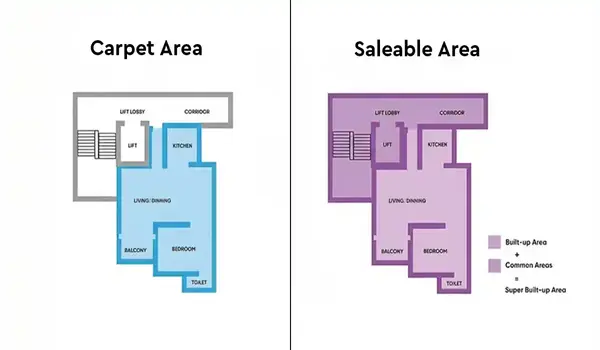
Almost always saleable, and the gap is larger than most buyers guess. Saleable area includes your share of corridors, lobbies, lift cores, stairs and the clubhouse. Carpet area is the floor you can actually stand on. People often assume 25 to 30 per cent loading. Parklane's RERA filing shows it can run well above that.
The 1 BHK sells at 567 to 571 sq ft saleable, but the filed average carpet is about 323 sq ft. That is roughly 43 per cent loading, not 25. That is not a scandal. It is how compact units work, because the fixed common areas are spread over less space. The Real Estate (Regulation and Development) Act requires carpet area in the agreement for sale. So the correct move is simple: ask for the carpet area of your specific unit and compute your own rate on it.
What to check on the payment schedule
Every schedule answers three questions. Read it for all three.
Is it construction-linked or date-linked? A construction-linked plan ties each instalment to a physical stage. A date-linked plan runs on fixed calendar dates. Parklane's is date-linked: 10 per cent on booking, 10 per cent on agreement, then 24 instalments of 3.2 per cent every two months from 10 December 2026 to 10 October 2030.
How front loaded is it? A schedule that takes 40 per cent before the foundation is finished transfers risk to you. Compare what is payable at booking, at agreement, and early on.
What happens if the developer is late? The agreement should carry the delay compensation the Act provides, at the same rate charged to you for late payment. If the two rates differ, ask why.
GST, and why the treatment matters
An under construction purchase attracts 5 per cent GST with no input tax credit. A completed property with an occupancy certificate attracts none. On a ₹65 lakh value that is ₹3.25 lakhs. On ₹1.50 crore it is ₹7.5 lakhs.
On a base-rate list, that is added on top. On an all-inclusive list it should already sit inside. Confirm which applies to your unit, in writing, because it is too large to assume.
A worked example: turning the sheet into one number
Here is the full calculation for one real unit, so the method is clear. Take the 2 BHK at 880 sq ft.
| Step | Calculation | Amount |
|---|---|---|
| 1. Starting price | From the fact sheet, all inclusive | ₹90,00,000 |
| 2. BESCOM | 880 × ₹75 + 5% GST | ₹69,300 |
| 3. BWSSB | 880 × ₹75 + 5% GST | ₹69,300 |
| 4. Generator | 880 × ₹85 + 5% GST | ₹78,540 |
| 5. Advance CAM, 24 months | 880 × ₹120 + 18% GST | ₹1,24,608 |
| 6. Maintenance corpus | 880 × ₹60 | ₹52,800 |
| 7. Registration | ₹90,00,000 × 7.5% | ₹6,75,000 |
| Total to own | ₹1,00,69,548 |
So a ₹90 lakh headline is a ₹1.01 crore purchase. About 11.9 per cent sits above the number on the sheet. Run the same seven steps on any unit you are offered. It takes five minutes, and it is the only way to compare two projects fairly.
Then divide that total by the carpet area of the unit. That gives you the one rate you can genuinely compare across developers. Keep the working in a simple spreadsheet, one column per project. Side by side, the cheapest headline is rarely the cheapest home.
The five things to get in writing
Not verbally. Not in a WhatsApp message from a channel partner. In a document from the developer.
| Ask for | Why it matters |
|---|---|
| The K-RERA registration number | Without it a project cannot legally be sold. Parklane's is PRM/KA/RERA/1251/309/PR/150926/008941. |
| Carpet area of your specific unit | The only area figure the Act requires, and the only fair basis for comparison |
| The total price for that unit | What "all inclusive" covers, plus possession charges and registration. One number. |
| The payment schedule, with its structure | Tells you how much risk you carry and when |
| The declared completion date | A liability the developer carries. Parklane's filing states 31 December 2030. |
Two habits worth having
Convert everything to a rate on carpet. Take the total price, divide by carpet area, and you have a number you can compare across any two projects honestly. It will look higher than the advertised rate. It is the real one. For the Parklane 1 BHK, that is about ₹20,124 per carpet sq ft against ₹11,464 on saleable.
Put every project on the same basis. Before comparing, convert a base-rate list to an all-inclusive total, or strip an all-inclusive price back to a base. Never compare one against the other.
Frequently asked questions
₹65 lakhs for 567 to 571 sq ft, per the fact sheet, excluding registration charges. The total cost to own, with possession charges and registration, is about ₹72.4 lakhs.
Saleable, as is standard in Bengaluru. On the Parklane 1 BHK the filed carpet area averages about 323 sq ft against 567 to 571 sq ft saleable, roughly 43 per cent loading.
About ₹4.88 lakhs at 7.5 per cent: 5 per cent stamp duty, 0.5 per cent cess and 2 per cent registration fee. It is paid to the state, not the developer.
Yes, at 5 per cent with no input tax credit. On a base-rate list it is added on top. On an all-inclusive list it should already be inside the price, so confirm in writing.
Floor rise is a premium for each floor as you go up, often ₹20 to ₹75 per sq ft per floor. PLC is a premium for a better position, typically 2 to 6 per cent of base. On an all-inclusive list, confirm how they are applied.
No, it is date-linked. After 20 per cent across booking and agreement, 24 instalments of 3.2 per cent fall every two months from December 2026 to October 2030.