Pre-launch homes in Karnataka: your rights before and after RERA registration
Many people put money into a flat before the project is registered with Karnataka's real estate regulator. It happens often, and the buyer is less protected than they usually realise. It helps to know exactly where protection begins. Every major safeguard for a home buyer in India starts on one day: the day the project is registered.
What the RERA Act forbids
Section 3 of the Real Estate (Regulation and Development) Act, 2016 is short and clear. A promoter may not advertise, promote, take bookings for, or sell any flat in a project until that project is registered with the Authority.
Only two small exceptions exist, and neither fits a project of any real size. They cover land of 500 square metres or less, or eight flats or fewer across all phases. If a development is built in stages, every stage counts as its own project and needs its own registration. That explains why Birla Trimaya holds four K-RERA numbers and Godrej MSR City holds two.
What an expression of interest really is
This distinction matters. An expression of interest, or EOI, is not a booking. Filling one in does not reserve a flat or assign you a unit. No payment is involved, and neither you nor the developer is bound by it.
Its only effect is to place you on a list. That list receives the price sheet, floor plans and payment schedule when they are released, usually ahead of the general public. That early information, and first pick of floor, tower and facing once bookings start, is the whole advantage of acting early. If anyone asks you for money before a registration number exists, stop there. That includes a "token", a "refundable deposit", or a cheque they promise not to cash.
Penalties for selling before registration
Under Section 59 of the Act, selling an unregistered project can bring a fine of up to 10 per cent of the project's estimated cost. Ignoring the Authority's orders repeatedly can lead to imprisonment of up to three years. K-RERA has sent increasingly firm notices to projects that were not registered.
Four protections that begin with registration
Once a registration number is issued, four safeguards take effect together.
Land records become public. Under Section 4, the promoter files title papers, an encumbrance certificate, approved plans and structural details. Anyone can read them without asking the sales office.
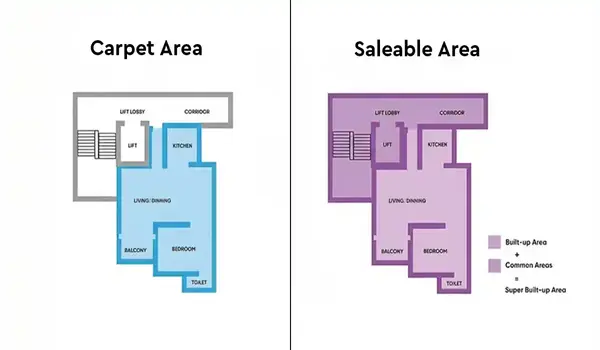
Carpet area has a legal meaning. The register lists each flat's carpet area using the Act's definition. This makes projects comparable, and it cannot quietly change later.
The completion date becomes binding. It is filed, made public, and backed by quarterly progress reports. If a project stops reporting, or its reported progress falls far behind its timeline, that tells you something a sales team will not.
Buyer money goes into a protected account. Seventy per cent of what buyers pay must sit in a separate account, released only as certified construction progresses. This stops money for one project being used on another, which is exactly how many stalled projects happened before the Act.
A real example of what registration records
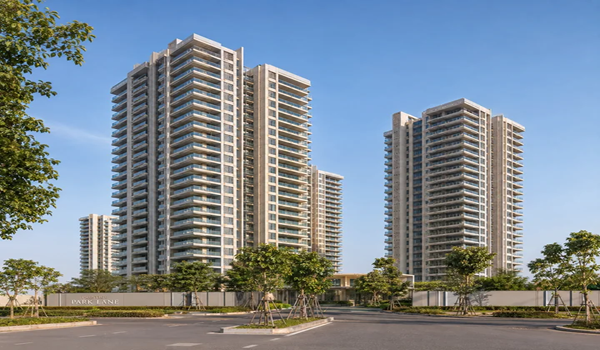
The easiest way to understand these four protections is to look at an actual filing. Prestige Parklane was registered on 15 September 2026, under PRM/KA/RERA/1251/309/PR/150926/008941. Here is what that step turned from marketing into public record.
| Protection | What the filing now states |
|---|---|
| Land and title on record | 45,401 sq m, approving authority KIADB, sanctioned plan DO3-KIADB-00128/26-27/BP |
| Carpet area defined | 94,788 sq m across 1,788 homes, broken down by configuration |
| Declared completion date | 31 December 2030, start 1 October 2026 |
| Escrow requirement | Applies to receipts from allottees from registration onwards |
Before 15 September, none of those details could be verified. Today, every one of them can.
How long registration takes
Once an application is complete, the Authority has thirty days to approve or reject it. If it does neither, the project is treated as registered, and a number must follow within another seven days. In a case brought by L&T, the Allahabad High Court ruled that this thirty-day limit is compulsory, not just a guideline. The slow part is usually putting the application together, not the thirty days.
A developer needs title records, an encumbrance certificate, sanctioned plans, environmental clearance and fire clearance. Near Devanahalli, an aviation height clearance from the Airports Authority is also needed, because the runways are close. Parklane shows the timing in practice. Its plan was approved on 13 August 2026, the application was acknowledged on 21 August, and registration followed on 15 September, inside the legal limit.
Decoding a Karnataka RERA number
Here is Parklane's number broken into its parts: PRM/KA/RERA/1251/309/PR/150926/008941.
| Segment | Meaning |
|---|---|
| PRM | Promoter registration |
| KA | Karnataka |
| 1251 / 309 | Reference codes assigned by the authority |
| PR | Project registration. AG here would mean agent, not project. |
| 150926 | Approval date, DDMMYY: 15 September 2026 |
| 008941 | Serial in the state database |
Remember the difference between PR and AG. An AG number shows that a person is licensed to sell property. It tells you nothing about any project. Passing off an agent number as a project registration is one of the most common tricks in property marketing. It works because few buyers know what to look for.
Always enter the entire number into the search on rera.karnataka.gov.in. Searching with part of it often fails on that portal. That is why buyers sometimes wrongly decide a real registration does not exist.
The trade-off of buying early
Buying before registration swaps certainty for a lower price and more choice. Early buyers usually get the lowest price the project will ever offer, before stage-by-stage increases, plus first pick of floor, tower and facing. Those benefits are real. In return, you give up the registered land details, the approved plan, an enforceable completion date and the protected account.
Until registration, all you hold is a marketing brochure and a relationship with a salesperson. The sensible approach is the one the law already points to. Register your interest, collect the information, and decide once both the price list and the registration number are available.
Frequently asked questions
You can register an expression of interest. But taking bookings, selling or accepting money for an unregistered project is banned under Section 3 of the RERA Act.
It makes land title and approvals public, gives carpet area a legal definition, sets an enforceable completion date, and keeps 70 per cent of buyer payments in a protected account.
Thirty days from a complete application. If no decision is made, the project is treated as registered and must receive a number within seven more days.
It means project registration. If that part reads "AG" instead, the number belongs to an agent and says nothing about the project.
Each phase of a staged development is legally a separate project, so each needs its own registration.
They can be fined up to 10 per cent of the project's estimated cost, and repeated disregard of the Authority's orders can lead to up to three years in prison.