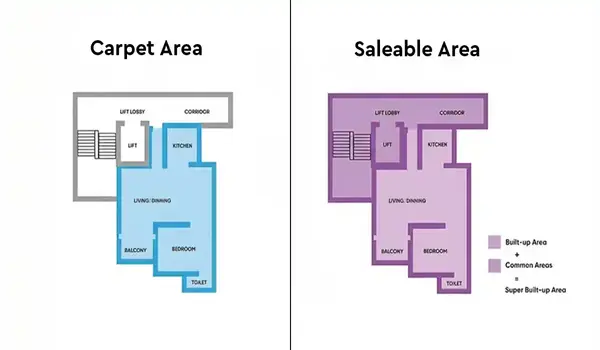
What is carpet area? RERA carpet, built-up and super built-up explained

Three numbers describe the same apartment. They can differ by more than sixty per cent. Which number a price is quoted against decides whether you are comparing two projects fairly, or fooling yourself. Only one of the three is defined in Indian law. This guide works through the definitions, the arithmetic and the registered figures, using the RERA filing for Prestige Parklane as a live worked example.
What is carpet area?
Carpet area is the usable floor inside your own walls. It is the only one of the three measures defined in law. The definition sits at Section 2(k) of the Real Estate (Regulation and Development) Act 2016. It reads as the net usable floor area of an apartment. It excludes the area covered by external walls, areas under services shafts, exclusive balcony or verandah, and exclusive open terrace.
But it includes the area covered by internal partition walls. Read that clause twice. Internal walls count toward your carpet area even though you cannot stand on them. This is what people mean by RERA carpet area. There is no second version. Where a project is registered, that figure is on the public register and in your agreement for sale.
What is built-up area?
Built-up area is carpet area plus the thickness of the walls, plus the balcony. It typically runs 10 to 15 per cent above carpet. It has no statutory definition. That absence is the first clue about how much weight to give it. Two developers can compute built-up differently and both be entirely within their rights.
What is super built-up area?
Super built-up area, also called saleable area, is built-up area plus your proportionate share of everything common. That means lobbies, staircases, lift shafts, corridors and the clubhouse. Sometimes it stretches to the generator room and the security cabin. It has no statutory definition either. This is the figure almost every Indian price list quotes.
Is the balcony included in carpet area?
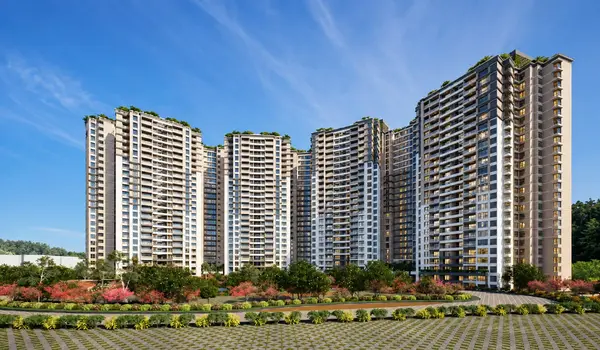
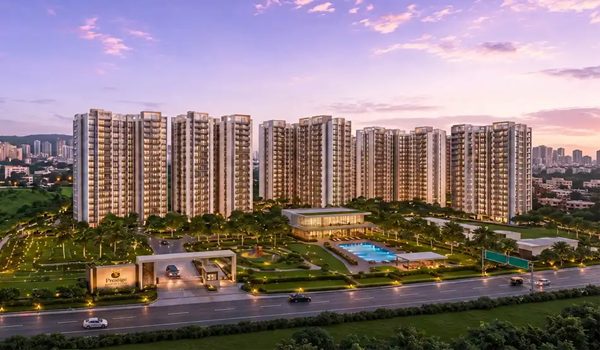
No. Under the RERA definition, an exclusive balcony or verandah is explicitly excluded from carpet area. So is an exclusive open terrace. This matters more than it sounds, because balconies are not small. The Prestige Parklane RERA filing declares exclusive balcony area separately from carpet area, exactly as the Act requires.
| Configuration | Registered carpet area | Exclusive balcony |
|---|---|---|
| 1 BHK | About 323 sq ft | About 32 sq ft |
| 2 BHK | About 565 sq ft | About 90 sq ft |
| 3 BHK | About 969 sq ft | About 98 sq ft |
Those are averages across each configuration, converted from the square metre figures on the register. A 3 BHK buyer is getting close to 98 sq ft of balcony that sits outside the carpet number entirely. If a brochure quietly folds the balcony into what it calls carpet area, the figure is not RERA carpet area. Ask which definition is being used.
How to calculate carpet area from built-up area
There is no single legal formula, because built-up has no legal definition. But the working method is simple enough.
- Start with the super built-up or saleable figure on the price list.
- Divide it by the loading factor to get carpet area.
- If you only have built-up, subtract roughly 10 to 15 per cent to approximate carpet.
- Then check your answer against the registered figure, because that is the one that binds.
Never treat the approximation as final. The register exists precisely so you do not have to estimate.
The loading factor, and what it tells you
Divide super built-up by carpet and you get the loading factor. It expresses how much of what you pay for sits outside your front door.
- 1.30 to 1.40 is efficient. Usually an older building with modest common areas.
- 1.50 to 1.65 is the current norm for a project with a clubhouse, lifts and landscaped grounds.
- Above 1.75 deserves a question. You are buying a great deal of corridor.
A higher loading is not automatically bad. A project with a genuine pool and a full clubhouse has to put that area somewhere, and it lands in your loading. What is bad is a high loading with nothing to show for it. Walk the common areas before you accept the number.
What the law actually requires
Since RERA, a promoter must disclose carpet area for every unit in a registered project. The agreement for sale must state it. Advertising and selling on super built-up alone, without carpet disclosed, is not compliant. What the law does not do is stop anyone quoting a price against super built-up. It only requires that carpet is disclosed where you can find it.
So the number in the advertisement stays the flattering one. The number that binds sits in the agreement and on the Karnataka RERA register. Prestige Parklane was registered on 15 September 2026 under PRM/KA/RERA/1251/309/PR/150926/008941. That registration is what put the carpet figures above into the public record. Before it, there was nothing official to check them against.
The one rule that makes comparison safe
Ask every project for the rate per square foot of carpet area. It is the only figure defined in law. It is the only one on the public register. And it is the only one comparable between two developers who measure everything else differently.
On the Devanahalli corridor this matters immediately. Some projects publish carpet because their RERA filings do, while others are commonly listed on aggregators at saleable. Compare across the two without normalising and your conclusion is wrong by more than half.
Five questions worth asking
- What is the carpet area of this specific unit? Not the configuration average, the unit.
- What is the loading factor? If the answer is vague, compute it yourself.
- Is the balcony inside carpet or outside it? Under RERA it is outside.
- What is in the common area I am paying for? A clubhouse you will use is different from a lobby you walk through.
- Does the agreement state carpet area? It must. If a draft does not, ask why.
The short version
Carpet is what you live in. Built-up is carpet plus walls. Super built-up is what you pay for. Only carpet is defined in law. Only carpet appears on the register. And only carpet lets you compare one project against another honestly.
Frequently asked questions
It is the net usable floor area inside the flat, measured to the inner face of the external walls. Internal partition walls are counted in. Balconies, open terraces and service shafts are left out.
RERA carpet area is the Section 2(k) definition described above. It is the only carpet figure that carries legal meaning, and it is the one a registered promoter must publish and honour.
No. An exclusive balcony or verandah is excluded by the Act. It is declared separately on the register, as the table above shows.
Built-up area adds wall thickness and the balcony to carpet area. The gap is usually 10 to 15 per cent. Built-up has no statutory definition, so treat it as indicative only.
Divide the super built-up figure by the loading factor. If the loading is 1.50 and the saleable area is 900 sq ft, carpet is about 600 sq ft. Always verify against the registered figure.
Because it produces a lower headline rate per square foot. The total price is unchanged. Only the denominator moves, which makes the project look cheaper per foot than it is.