Kempegowda International Airport and what it does to North Bangalore property

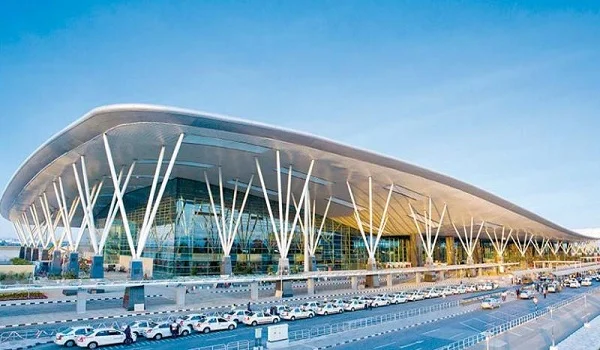
North Bangalore exists as a property market because of one asset. Remove Kempegowda International Airport, and Devanahalli is farmland 35 kilometres from the city. Understanding what the airport is, how fast it is growing and what is being built around it is the whole of the corridor's investment case.
Kempegowda International Airport today
| Metric | FY 2025-26 |
|---|---|
| Passengers handled | 44.47 million |
| Cargo | 532,000 tonnes |
| International traffic growth | +23.9% year on year |
| Cumulative passengers since 2008 | Crossed 400 million |
For scale, 44.47 million people is roughly two thirds of Karnataka's population passing through one complex in a year.
Two runways, and why it matters in December
The second runway opened on 6 December 2019. It is 4,000 metres by 45 metres, with CAT-IIIB instrument landing capability. That gave Bengaluru India's first independent parallel runway operations. Both runways can be used at the same time, rather than alternately.
CAT-IIIB is the part worth understanding. It allows landings in visibility down to around 50 metres. Every winter, North Indian airports close for hours in fog and flights divert. Bengaluru keeps operating.
For an airline planning a base, or a logistics operator planning a hub, that reliability is worth more than gate count. A third runway was refused. The operator is instead pursuing a second airport for the region, which is worth watching on a ten year view.
Terminal 2 and what comes next
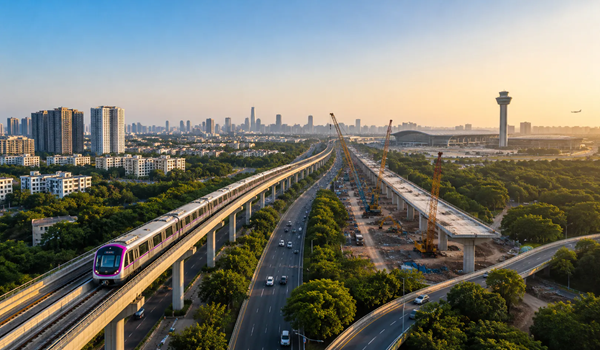
Terminal 2 lifted capacity from about 25 million passengers a year to roughly 60 million. It is not finished growing.
- A ₹19,800 crore expansion is under construction, adding 2.78 lakh square metres of terminal, 40 apron stands, and a 28,000 square metre walkway linking T1 and T2.
- Completion is targeted for 2028, taking capacity beyond 85 million passengers a year.
- ₹17,000 crore of operator capital expenditure is planned to 2029, across airside, landside and terminal.
- A new air traffic control tower is due in 2027, and a western crossfield taxiway in late 2026 or early 2027.
Committed capital of that size does not reverse. It is the most reliable single fact on this corridor.
Bengaluru Airport City, the part most buyers miss
Inside the airport boundary sits a 460 acre business district. Its master plan runs to 2068, with a build-out target above 45 million square feet by 2040. It is not an airport facility. It is a city district that happens to be at an airport.
- Phase one: a 2 million square foot business park in four blocks, aimed at global capability centres.
- Hospitality: the Taj expanded to 370 keys, and a Ginger of 325 keys targeted for end 2026.
- An arena, with Live Nation as global partner. It is the first large-scale venue inside an airport ecosystem in India.
- In June 2026, Prestige Group signed with Bangalore Airport City Limited to develop a convention centre, luxury hotels and premium offices there.
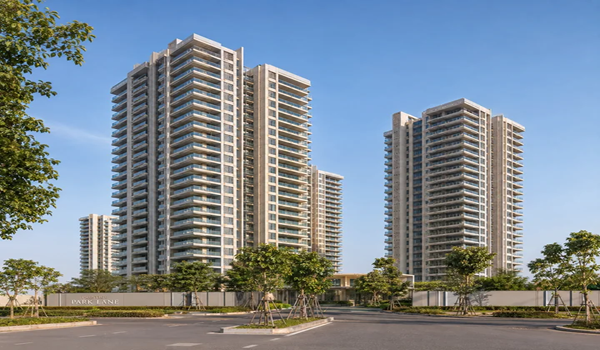
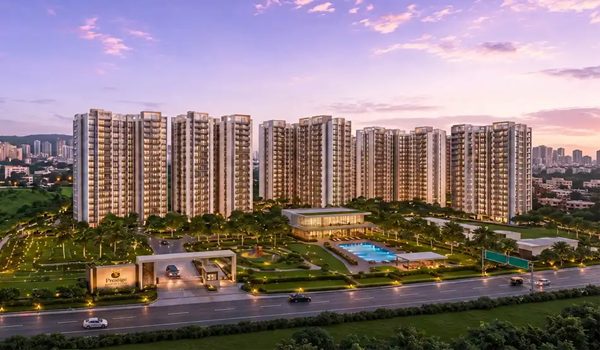
That last point matters to anyone evaluating Prestige Parklane. The same group is building commercial property in the district up the road. It is not a passing interest in the corridor.
What an airport does to residential demand
Three distinct effects, and they arrive at different speeds.
Direct employment, immediately. An airport at this scale employs tens of thousands, directly and through contractors: crew, ground handling, cargo, security, retail, engineering and maintenance. Crew in particular need to live close, because report times are unforgiving.
Cluster employment, over years. The airport is why the KIADB Aerospace Park is here, why Boeing built a ₹1,600 crore campus, and why the logistics belt formed. That employment is larger than the airport's own.
Office employment, over a decade. The Airport City business park is the newest layer, and the one that converts renters into buyers. Global capability centre salaries support a purchase at ₹1 crore and upward. Devanahalli is strong on the first two effects and early on the third. That is precisely why it prices below Whitefield and Sarjapur Road, and it is the gap the corridor is closing.
How close is close enough
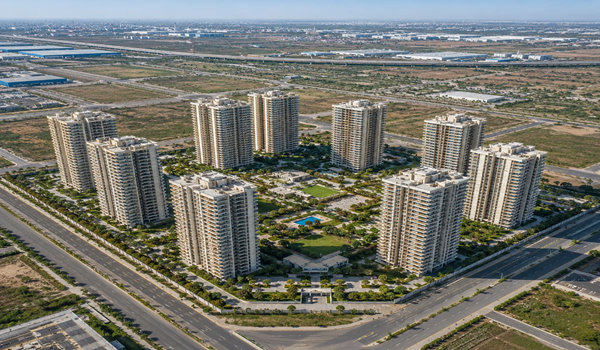
Prestige Parklane sits roughly seven kilometres from the terminal area. In practice that is a fifteen to twenty five minute drive, depending on the hour, the approach road and the terminal. Fifteen is achievable early in the morning. It is not the number to plan an evening departure around. Proximity to an airport is a preference, not a universal good.
It suits aviation and aerospace employees, frequent business travellers, NRI buyers who fly several times a year, and anyone working in the industrial cluster.
It suits less well a household that rarely flies and commutes daily to Whitefield or Electronic City. No amount of airport growth improves that journey. One thing worth doing on a site visit is to stand still for ten minutes at a busy hour and listen. Two parallel runways operate here, approach paths matter, and the answer differs across the corridor.
How the airport timeline lines up with Parklane
The airport's growth and the project's build run in parallel, and the dates line up usefully.
| Year | Airport and corridor | Prestige Parklane |
|---|---|---|
| 2026 | Taxiway work; Ginger hotel due | RERA registered 15 September; start 1 October |
| 2027 | New ATC tower; metro airport section targeted | Construction under way |
| 2028 | Terminal expansion to 85 million+; full metro line targeted | Towers rising |
| 2029 | Operator capex programme completes | Finishing stages |
| 2030 | Airport City continues build-out | Declared completion 31 December |
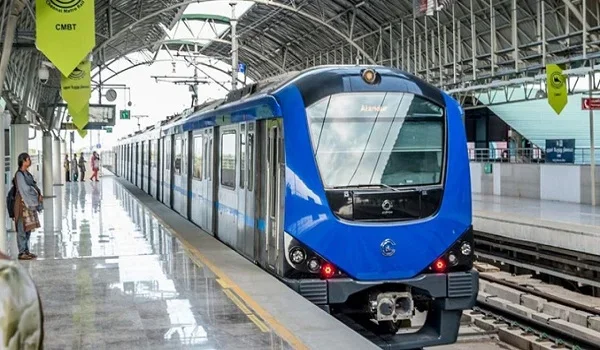
By handover, the terminal expansion and the metro should both be operating. Residents would move into a corridor where that infrastructure already exists.
The bottom line
Consider what sits here. An airport handling 44 million passengers, with two parallel CAT-IIIB runways, spending ₹19,800 crore to reach 85 million. Inside its own boundary, a 460 acre business district planned to 45 million square feet. That is not an amenity near a housing project. It is the reason the housing project exists.
Frequently asked questions
44.47 million in FY 2025-26, with international traffic up 23.9 per cent. It has handled more than 400 million passengers since opening in 2008.
About seven kilometres from the terminal area, which is a fifteen to twenty five minute drive depending on the time of day and the terminal.
A 460 acre business district inside the airport boundary, planned to exceed 45 million square feet by 2040, with offices, hotels and an arena.
It anchors demand through direct, cluster and office employment. The effect builds over years rather than instantly, and it is strongest for buyers who work on the corridor.
Its runways have CAT-IIIB instrument landing capability, allowing landings in visibility down to about 50 metres.
It depends on your position relative to the approach paths. Two parallel runways operate here, so visit the specific site at a busy hour before deciding.